PyMC elicito: A Python package for expert prior elicitation using PyMC#
Key info :


PyPI : in progress
Conda : in progress
Tests :


Other info :


Status#
Prototype:
This project is just starting up and the code is all prototype.
Pymc-elicito re-implements the Python package elicito using pymc instead of tensorflow(-probability) as dependency.
Description#
Expert prior elicitation aims to define prior distributions for parameters within a Bayesian model that accurately incorporate the expectations of a domain expert. The elicito computational framework supports the modular implementation of diverse expert prior elicitation methods.
Modular Capabilities of elicito#
Owing to its modular design, elicito accommodates key components across the entire elicitation workflow:
- Generative Models: Support for a wide range of generative models (i.e., the statistical models describing the data-generating process).
- Expert Knowledge: Flexibility in defining different types of expert knowledge (i.e., the specific information elicited from the domain expert).
- Elicitation Techniques: Implementation of various types of elicitation techniques (e.g., quantile-based, histogram-based, or moment-based elicitation).
- Loss Functions: Integration of loss functions (i.e., the criterion used to quantify the discrepancy between the expert knowledge and the simulated model quantities).
Computational Workflow#
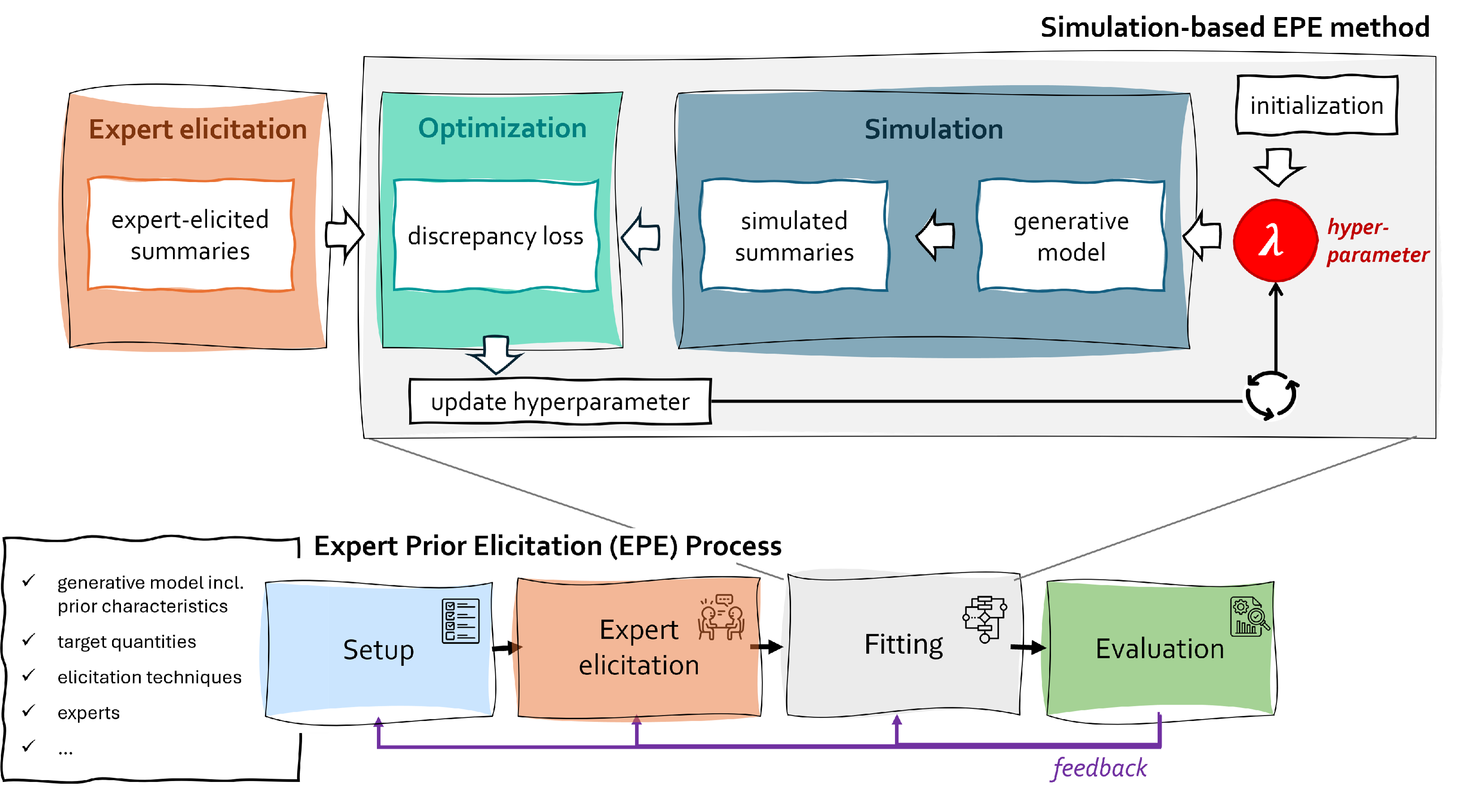
The core logic of the expert prior elicitation method proposed in Bockting et al. (2024) can be summarized in a five-step workflow:
Core logic of method underlying elicito
- Define the generative model: Specify the generative model, including the functional form of the data distribution and the parametric family of prior distributions.
- Define target quantities and elicitation techniques: Select the set of target quantities and determine the elicitation techniques to query the expert (cf. elicited summaries).
- Simulate elicited summaries: Draw samples from the generative model and compute the corresponding set of simulated elicited summaries.
- Evaluate discrepancy between simulated and expert-elicited summaries: Assess the discrepancy between the simulated and expert-elicited summaries using a multi-objective loss function.
- Adjust prior hyperparameters to minimize discrepancy: Apply an optimization scheme to update the prior hyperparameters such that the loss function is minimized.
Getting started#
ToDo
The Elicit class#
The primary user interface of elicito is the Elicit class, through which the user can specify the entire elicitation procedure. The arguments of the Elicit class are designed to capture all necessary information required to implement an elicitation method.
A brief overview of these arguments is provided below:
model: Defines the generative model used in the elicitation procedure.parameters: Specifies assumptions regarding the prior distributions over model parameters, including (hyper)parameter constraints, dimensionality, and parametric form.targets: Defines the elicited statistics in terms of target quantities and corresponding elicitation techniques. Also specifies the discrepancy measure and weight used for the associated loss component.expert: Provides the expert information that serves as the basis for the learning criterion.optimizer: Specifies the optimization algorithm to be used, along with its hyperparameters (e.g., learning rate).trainer: Configures the overall training procedure, including settings such as the random seed, number of epochs, sample size, and batch size.initializer: Defines the initialization strategy for the hyperparameters used to instantiate the simulation-based optimization process.networks: Specifies the architecture of the deep generative model; required only when using non-parametric prior distributions.
By configuring these core components, elicito supports a wide range of elicitation methods, including both structural and predictive approaches, univariate and multivariate as well as parametric and nonparametric prior distributions.
Main References#
- [Software Paper] Bockting F. & Bürkner PC (2025). elicito: A Python package for expert-prior elicitation. arXiv. Preprint
- [Methods Paper] Bockting F., Radev ST, Bürkner PC (2024). Simulation-based prior knowledge elicitation for parametric Bayesian models. Scientific Report, 14(1), 17330. PDF
- [Methods Paper] Bockting F., Radev ST, Bürkner PC (2025). Expert-elicitation method for non-parametric joint priors using normalizing flows. Statistics and Computing. PDF